How does a Matrix MLM Plan Work?
The Matrix MLM Plan is a widely adopted compensation model in direct selling, built to promote both individual growth and team development. Unlike other MLM compensation Plans, the matrix plan limits the width and depth of the network, offering a clear and predefined genealogy layout.
To manage this structured network efficiently and automate commission distribution, many MLM companies rely on Matrix MLM Software, which streamlines plan management, tracks downlines, and ensures accurate payouts.
What is the Matrix MLM Compensation Plan?
The Matrix MLM Plan, commonly called the Forced Matrix compensation structure, is built on a predefined width and depth defined by the Width × Depth formula. It begins by placing two members on the first level, and once those positions are occupied, all additional members are automatically positioned in the next available slots within the hierarchy, a process referred to as spillover.
This compensation model restricts width more than depth, motivating members to concentrate on expanding their downline. The Matrix Plan features a pyramid-style layout with predetermined levels (depth) and positions per level (width), which limits how many distributors you are able to sponsor directly on your first level.
Master Your Matrix MLM Plan with Volochain MLM Software
Volochain MLM Software delivers powerful Matrix MLM solutions packed with advanced features. It streamlines complex matrix structures and enhances overall MLM business management. With this top-tier MLM software, you can efficiently handle member tracking, commissions, payouts, and all essential network metrics. Our Forced Matrix MLM system allows you to define the width and depth of your matrix and assign fixed positions to distributors. Whether you need a 2×2, 3×3, or any customized matrix setup, Volochain MLM Software offers flexible and scalable options to meet your business needs.
Step into success—join our powerful Matrix MLM plan today!
Matrix MLM Plan Structure
Matrix Genealogy Tree represents the network structure followed by MLM companies that implement Matrix MLM plans. Though the Matrix MLM Plan operates with a predetermined width and depth, these values are set in advance by the MLM company. The selected width and depth usually depend on the product type, sales model, and distributor network goals. Some of the most commonly used Matrix MLM structures include 2×2, 4×7, 5×7, 3×9, and 2×12.
Working of Matrix MLM Plan
The most important decision an MLM company must make when implementing a Matrix MLM Plan is determining how many members will be placed on each level. They also need to decide the ideal number of genealogy levels that will deliver maximum benefits. These two elements define the width (members under each parent) and the depth (Total number of levels) required for an effective Matrix MLM business Plan.
A Matrix MLM plan follows a fixed, predefined width and depth, ensuring no member is placed outside these set limits. When a position doesn’t align with the designated structure, the extra members automatically spill over to the next level in the matrix MLM.
Distributors need to support their downline members to ensure the growth of their organization, as the Matrix MLM compensation plan has a limited width. When the first level is full, distributors must place new recruits deeper in their downline. These new distributors are then positioned in the next available spot. As distributors grow more experienced in their roles, they can strategically place new members in the optimal positions within the matrix MLM Plan.
How a Matrix MLM Plan Works (With Example)
Consider a 3×2 Matrix MLM plan, where 3 represents the width and 2 represents the depth of the matrix. The diagram below illustrates this 3×2 matrix.
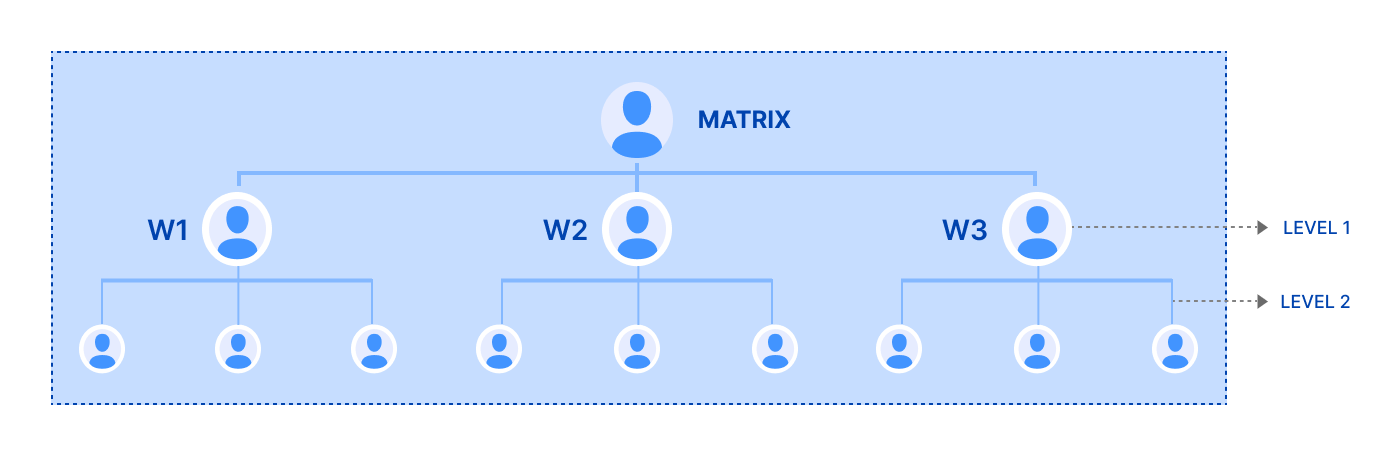
In a Matrix MLM plan, the width (3) is the maximum number of distributors allowed at each level, and the height (2) is the total number of levels in the matrix. When the first level is full with 3 distributors, any new members are placed on the second level. In this example, the matrix has only 2 levels.
Each of the 3 members on the first level can have 3 distributors under them on the second level. This results in a total of 9 members on the second level. Adding distributors to the second level is called a spillover in matrix MLM plan. In a 3*2 matrix, the total number of distributors will be 13 (Sponsor - 1, First level - 3, Second level 9 = 13 members). The matrix 3*2 is completed once it forms these 13 members.
MLM Compensation Structure
In a Matrix MLM plan, members can earn compensation based on their rank, the number of recruits, and product sales. Common compensation methods include Sponsor Bonus, Level Commissions, Matching Bonus, Position Bonus and Forced Matrix Bonus.
Let’s use a 3×7 matrix as an example:- you are at the top with 3 members on your first level. Your second level has 9 members, the third level 27, continuing down to the seventh level, which holds 2,187 members. If filled up, you can earn bonuses from a total of 3,279 people! Many top leaders in the MLM industry have organizations that are tens or even hundreds of times larger than this. This clearly illustrates the power of exponential growth in a matrix structure.
When a new member joins the company through a sponsor’s referral, the sponsor receives a sponsor bonus. Additionally, with the joining of the same member, the new member’s uplines are compensated with level commissions.
Once the matrix MLM structure is completely filled with members, it is common in many MLMs using a matrix plan to reward them with a forced matrix MLM bonus.
Bonuses in Matrix MLM Plan
1. Sponsor Bonus
The sponsor bonus is the amount earned for enrolling downline members on the frontline in a matrix MLM plan.
2. Level Bonus
Level commissions are the compensation earnings received by upline members in a matrix MLM when a new member is placed in their downline. The number of upline levels eligible for level commissions varies depending on the MLM’s compensation plan.
3. Matching Bonus
A Matching Bonus is a commission that sponsors receive based on the earnings of the downline distributors they have personally sponsored.
4. Forced Matrix Bonus
All members within a matrix genealogy structure become eligible for a Forced Matrix MLM Bonus once the matrix is fully completed.
5. Rank Bonus
This bonus is paid to members in a matrix MLM plan who reach a specific rank or level within the matrix. It is usually a one-time payout and the amount varies based on the rank achieved.
6. Infinity Bonus
This bonus is Paid to high-ranking members who achieve a certain level of success in the MLM matrix plan, calculated as a percentage of the sales or commissions generated by members beyond a specified number of levels.
Pros of Matrix MLM Plan
1. Spillover Effect
When a sponsor recruits more members than their matrix can accommodate in the downline, spillover happens.The extra members are placed under their existing downline, allowing those downline members to benefit and accelerating the growth of their network
2. Team Collaboration
Since each participant is assigned a fixed-width matrix, team members work together to fill their matrix positions. This collaborative effort creates a supportive environment and strengthens teamwork as members help one another succeed.
3. Fast Cycling
When a member completes their matrix and earns a commission, it is called cycling. Compared to broader MLM structures, matrix plans allow faster cycling, enabling members to receive payouts more frequently and generate income more quickly.
4. Focus on Depth
A deep structure forms when members expand their downline by adding new distributors under existing members. Those with a strong downline benefit from this depth through additional support, mentoring opportunities, and enhanced earning potential.
Cons of Matrix MLM Plan
1. Limited Width
Each member can have only a limited number of direct recruits, as there is a fixed number of frontline positions available. This restricts network growth through narrow channels and limits expansion opportunities.
2. Spillover Dependency
Members who depend too much on spillover may become complacent and neglect active recruitment. If spillover does not occur as expected, it can result in slower network growth and reduced earning potential.
3. Balancing Placement
To maximize their earning potential, members need to strategically place new recruits within their organizational structure. Careful leadership and planning are essential to avoid unbalanced matrix positions and missed income opportunities.
4. Income Disparity
In a matrix plan, earnings depend on member positioning and downline activity, which can create income disparities. Such disparities may lead to dissatisfaction, reduced motivation, and higher attrition among members with lower earnings.